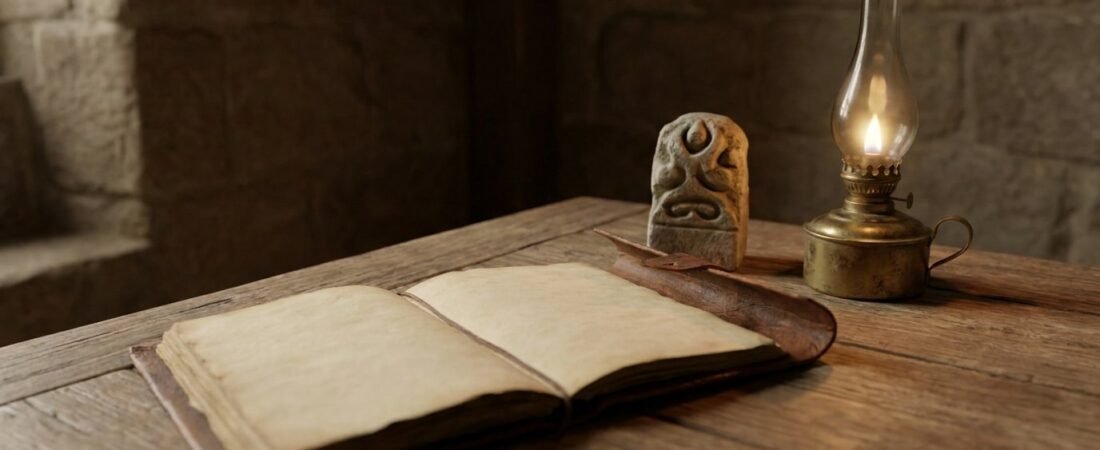
Editorial note — This article is about how consecration is documented for online talisman orders, why a written record is a stronger and more honest standard than a video clip, and how to check a record once you receive it. A record proves that a process took place. It does not guarantee an outcome, and no page of ours will ever say it does.
When you buy a talisman online, you are paying for two things at once: a physical object and a claim that it was ritually activated. The object you can hold. The activation you cannot, because it happened, by definition, before the talisman reached you, in a room you were never in.
That gap is where trust lives or dies. Sellers fill it in different ways. Some render a dramatic video and hope it carries the weight. We do something plainer and, we think, more useful: we keep a written consecration record, and it ships with the order.
The gap that online buying creates
In person, ritual trust is built by presence. You see who is doing the work, you hear the recitation, you watch the paper being prepared. Online, all of that is stripped away and replaced by interface: a product photo, a button, a tracking number. Nothing in that flow tells you whether any ritual took place.
This is not a small problem. A talisman that has not been consecrated is a nicely drawn piece of paper, and a buyer has no way to tell the difference from a screen. Any honest seller has to admit that and then offer something checkable in place of presence. That “something” is where the standard is set.
Why “video proof” is a weak standard
Footage feels convincing, which is exactly why it is a poor test. Consider what a clip actually shows.
- It shows that a camera was present. It does not show the lineage of the person in frame, or whether the rite was the one described.
- It is trivial to stage. Incense, a robe, and a folded paper can be filmed in ten minutes, repeatedly, for any order.
- It changes the rite. A consecration performed for an audience is not the same act as one performed privately for the person who asked. Many practitioners refuse to film for that reason.
- It proves nothing about your specific talisman. A generic clip can be attached to a hundred different orders.
None of this is meant to suggest that every seller who uses video is dishonest. It is meant to point out that video is theatre, and theatre is not documentation.
A clip can be staged in an afternoon. A record, to be worth anything, has to stay consistent order after order, year after year.
What a written consecration record contains
A record worth keeping is specific. For each order we log the same fields, so that any two records can be compared without vagueness:
- The talisman form, in romanised spelling and written characters — for example a Xuanzi fu (玄滋符), the northern talisman of the Wufu scripture.
- Its source text, named and dated, with where the text is preserved.
- The functional class — protection of a home, support for study, and so on.
- The date of drawing and the date of consecration.
- The ritual stage completed before the paper was folded, sealed, and dispatched.
Notice that none of these fields describe your health, your money, or your love life. They describe work done. That is deliberate. The moment a record starts describing outcomes, it has stopped being a record and become a sales pitch.
How to verify what a record claims
The value of a written record is that you can test it. Do not file it away unread. Work through it:
- Does it name a form and a source, or only describe the talisman in adjectives?
- Are the drawing and consecration dates present and coherent?
- Can the cited scripture be found in a public catalogue or archive? It should be a real, datable text, not a phrase invented for the page.
- Does the record promise anything about your life? A promise there is a defect, not a bonus.
If a claim does not survive these checks, ask about it directly. A seller with a real process will not mind. A seller without one will become vague.
A record is also most useful over time. A seller who keeps logs produces a consistent paper trail — the same fields, the same format, order after order. Inconsistency is itself a signal: a record with no dates here, a missing form name there, a source that changes spelling between orders. You are not auditing one document in isolation. You are looking at whether a real process stands behind it.
Documentation is not a promise
This is the part that most marketing pages leave out, so we will state it plainly. A consecration (开光, kai guang) is a ritual act. A record documents that act. Neither one controls your circumstances.
A talisman is a ritual expression of intention. You set the intention; the paper carries it; the ritual marks the passage. If someone sells you a talisman with a “proof” that promises wealth, health, or a specific person’s affection, the proof is inflated to cover a claim that should never have been made. Health is a good example: if you are unwell, an offering or a talisman may accompany your care, but it never replaces seeing a doctor, and any seller who implies otherwise is doing you a disservice.
What to ask before you order
You are entitled to ask, and a serious seller will expect it. A short list that separates real operations from decorative ones:
- Which scripture is this form traced from, and where is it published?
- Do I receive a written record of drawing and consecration with my order?
- Who performs the consecration, and within what lineage?
- What exactly will the record claim — and, just as important, what will it not claim?
If the answers are fuzzy, that is your answer. For a fuller set of warning signs, see 5 Red Flags When Buying Taoist Talismans Online.
Red flags in “consecration proof”
When a seller leans hard on proof, watch for these patterns:
- A generic clip sent for every order, with no reference to your specific talisman.
- A “certificate” with ornate borders but no form name, no source text, and no dates.
- Claims that the proof guarantees a result.
- Refusal to answer which lineage or text stands behind the work.
Each of these replaces checkable detail with atmosphere. That is the tell.
A record is not the ritual
One last caution, aimed at us as much as at anyone. It is possible to become so focused on documentation that the document starts to feel like the practice. It is not. The record is a witness, kept so that an overseas buyer can have some honest footing. The work — the drawing in cinnabar (朱砂) on yellow ritual paper, the ritual, the intention you bring — is what actually happens.
If you keep that frame, the document does its job: it lets you trust the process without being asked to believe in a result. If you want to understand why the source line behind the record matters, read Why Maoshan Lineage Matters for Talisman Buyers.
External references
- Daoist Studies — academic portal on Taoist ritual and lineage practice.
- Stanford Encyclopedia of Philosophy — Daoism — scholarly background on Taoist concepts.
- Internet Archive — public catalogues useful for checking whether a cited scripture exists.
Shop hand-written talismans
Every talisman in our shop is hand-drawn in cinnabar on yellow ritual paper and consecrated before it is sealed, and each order ships with a written record. Popular starting points are the Personal Protection Talisman and the Spirit Clearing Talisman. Because each piece is made by hand, we take orders by WhatsApp appointment rather than instant checkout — ask us anything before you decide, and we will tell you what the record will and will not say.