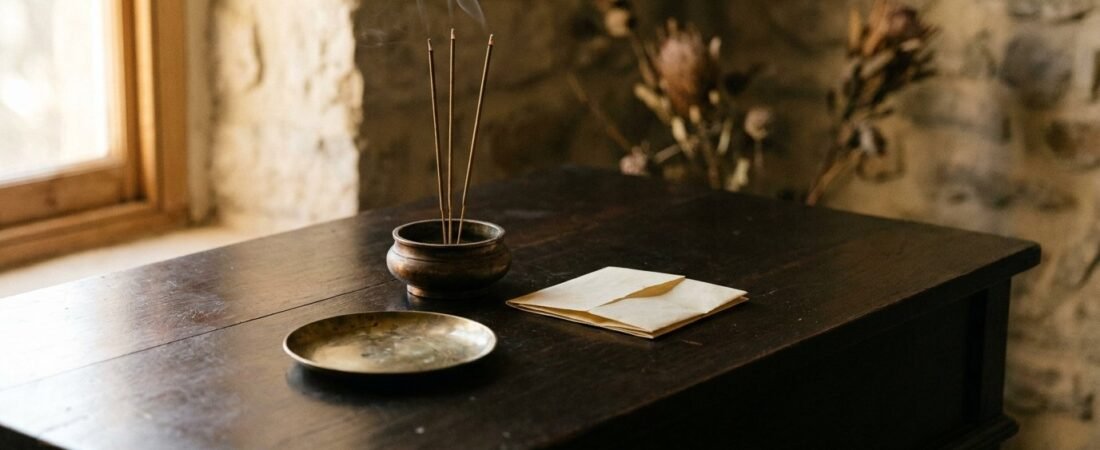
Editorial note · 编辑说明 — This guide covers the practical etiquette of offering incense before a blessing ritual, adapted for Western homes and apartments. We can describe how the offering is done in Taoist folk practice. We cannot promise that the ritual produces a specific outcome; the offering is a ritual expression of attention and respect.
What the incense is doing
In Taoist practice, incense is not primarily a scent. It is an offering and a messenger. The smoke rising from a stick is read as a signal of attention carried upward, and the act of lighting it marks a threshold — the moment an ordinary day becomes a ritual one. In Chinese it is called xiang (香, incense), and the same word shades into “fragrance” and “offering.”
Because the offering is a signal of attention rather than a purchase of favor, the etiquette around it is simple: cleanliness, calm, and sincerity. Get those three right and the details follow.
Before you begin: preparation
A little preparation separates an offering from a careless gesture. None of it is complicated.
- Wash your hands and, if you can, rinse your mouth — a light cleansing before contact.
- Clear and dust the surface where you will offer.
- Silence your phone and, if possible, close a door for a few unhurried minutes.
- Settle your breathing before you strike a light. The offering starts with the mind, not the flame.
- Decide in one sentence what this ritual is for, so your attention has a center.
Lighting and holding: the etiquette of three sticks
The most common custom is three sticks of incense, offered together. Customs vary by lineage and household, so treat these as the widely practiced form rather than a universal law.
- Light the sticks from a single source and let them catch fully.
- Do not blow out the flame with your breath if you can avoid it; fan it gently with your hand instead, out of respect.
- Hold the bundle upright between your palms, roughly at brow height.
- Name your intention silently. Keep it short and honest.
- Plant the sticks upright in a holder, evenly spaced if you like the symmetry of three.
Three sticks are often read as offering to the three realms or as a triple gesture of intent; a single stick is also perfectly respectful when that is what you have.
Posture and bowing
Posture carries as much meaning as the incense itself. Stand or sit upright, feet still, hands together. A calm body steadies a scattering mind, which is why the tradition treats bearing as part of the offering.
Bowing, if you bow, is a measured gesture rather than a performance — typically three unhurried bows, done with the whole torso, not just the head. There is no scoring system and no audience. A person alone in a small flat bowing once with care has done the practice fully.
If you are offering on behalf of someone else — a sick relative, a friend far away — the custom at home is simply to name them when you state your intention. No separate liturgy is required. The point is that the person is held in mind at the moment the incense rises, which is exactly what an offering is for.
Rhythms vary and none is obligatory. Some keep a single holder and dish of ash for years, replacing only the sticks; others make an offering once a month or once a season. What the tradition asks is not frequency but sincerity: when you do offer, mean it, however briefly.
When you finish, do not treat the last ember as an afterthought. Let it end on its own if you can, and close with a word of thanks in your own language. The tradition is indifferent to eloquence; it notices whether you were present.
The offering is not measured by the incense but by the attention. A single stick lit with a clear mind outweighs a whole bundle lit in a hurry.
Do not point, do not waste, do not hurry
Folk etiquette around incense carries a few small prohibitions, and they are worth knowing so you can honor the tradition rather than skip it.
- Do not point a lit stick at people, or wave it around as you talk.
- Do not let sticks burn down and scorch the surface below; a holder exists for a reason.
- Do not rush the offering to get it over with. The unhurried stretch is part of it.
- Do not use incense to show off a costly brand. The tradition is indifferent to price.
- Do not light it carelessly near curtains, paper, or a smoke detector.
Real apartments: smoke, alarms, and alternatives
This is where Western renters need the honest adaptation. A studio with a fire alarm and a roommate who dislikes smoke is not a monastery hall, and the tradition has always adapted to its house.
- Ventilation first. Crack a window or use a small room, and choose a low-smoke Japanese-style stick or a cone over a heavy bundle.
- Smoke-sensitive? Offer a battery tea light, or place an unlit stick in the holder as a dedication. The intention transfers.
- Shared space? Ask before you burn anything, and keep the offering brief. Respect for others is part of the etiquette.
- Hotel or dormitory? A cup of clean water offered on a bedside table is a complete, smoke-free offering.
- Asthma or a sensitive pet? Skip the smoke entirely. A water offering is not a lesser substitute; in some traditions it is the preferred one for the home.
Before a blessing ritual specifically
The offering is often the opening of a larger ritual, so the sequence matters. If you have ordered a talisman and want to prepare the space before it arrives or before a blessing you are conducting, the customary shape runs like this.
- Clean the surface and set the offering — water, a light or incense, perhaps a small dish of fruit.
- Light the incense and state your intention for the ritual that follows.
- Pause in silence for a short while. This is the actual work, not the pause before it.
- Proceed with your blessing or your placement of the talisman — for example, setting a personal protection talisman or a peace and safety talisman in its place.
- Close by letting the incense finish naturally, and give thanks in your own words.
Pace the incense to the ritual, not the other way around. If the sticks finish before you do, that is fine; if you finish first, let them burn out undisturbed.
Everyday rhythm, not a performance
Many households make a short offering in the morning and another in the evening, but a keeper of a single talisman needs no schedule at all. An offering when you feel the need, done with care, is enough. The purpose is regularity of attention, not volume of incense.
If the smoke bothers your building or your body, remember the principle plainly: the tradition values the intent over the form. A quiet minute with a clear mind and a clean surface honors the same thing the smoke is meant to carry. That is why our practice offers a water alternative for homes where burning is impractical.
External references
- Encyclopaedia Britannica — Taoism — Background on Taoist worship and household ritual.
- Daoist Studies — Scholarly resources on Daoist liturgy and offerings.
- Stanford Encyclopedia of Philosophy — Daoism — On the place of ritual in Daoist practice.
Shop hand-written talismans
If you are preparing to place a piece with an offering, the peace and safety talisman suits a home setting, and the personal protection talisman suits the person. Each is hand-drawn in cinnabar on yellow ritual paper and reserved through our WhatsApp appointment system, one piece at a time.