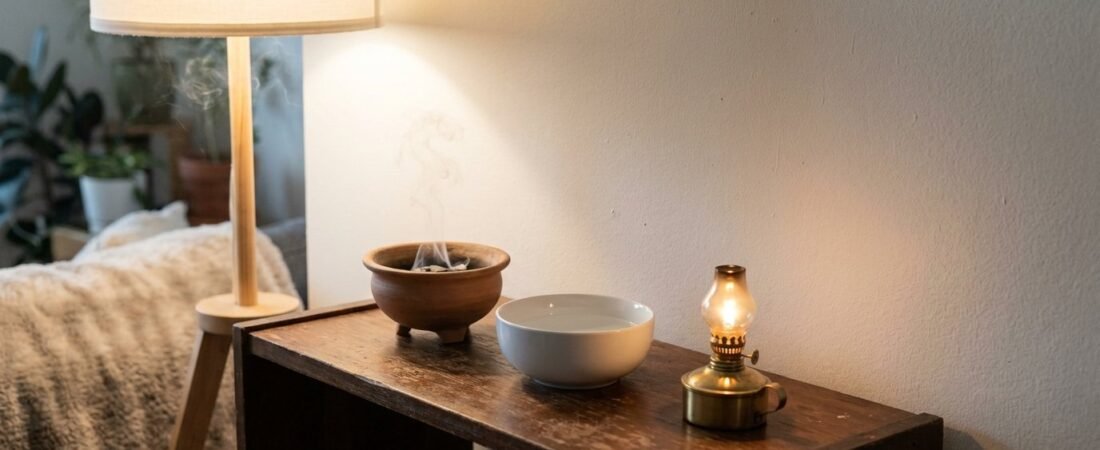
Editorial note — This guide is for readers living in rented flats in the West who want a small Taoist home altar but cannot burn large incense or disturb neighbors. We describe the Maoshan (茅山) folk approach and the hand-drawn talismans we make. An altar is a place for attention and ritual; we make no claim that it changes outcomes in your life.
What a home altar is actually for
A home altar is not a power source you switch on. It is a designated place where you stop moving and pay attention. In a small flat that might be the corner of a desk; in a house it might be a low shelf. The point is repetition and focus — you return to the same spot, and the spot reminds you why you came.
For a lay seeker abroad, that is the whole realistic value. It gives shape to a practice that would otherwise float free in a busy week. You do not need to be a priest, you do not need a dedicated room, and you do not need anyone’s permission. A shelf, a glass, and five quiet minutes are a complete altar.
What matters is consistency, not scale. A large shrine you never visit is worth less than a small one you return to most mornings. Start with the smallest setup you will actually keep, and let it grow only if the habit does.
The Maoshan background, briefly
Daofuxuan (道符轩) works within the Maoshan (茅山) tradition and references the Wufuxu (五符序), the Scripture of the Five Talismans of the Numinous Treasure (太上洞玄靈寶五符序) — the earliest surviving Taoist scripture devoted specifically to talismans, preserved in the Zhengtong Daozang (正统道藏), the Ming-era canon of 1445. Household ritual and offerings run through this material, which is why a modest home altar is a familiar idea in the tradition rather than an invention.
A minimal setup that fits a rented flat
You do not need statues, a special room, or furniture. A clean, stable surface at roughly chest height is enough. Everything below can be packed away in a minute if a landlord visits.
- A surface — one end of a bookshelf, the top of a small cabinet, or a dedicated box you open when you use it.
- A glass of clean water — the standard offering, replaced daily.
- A small bowl of rice or one piece of fruit — optional, and appropriate to place fresh when you sit down.
- A talisman or a small image — resting propped or in a frame. A Home Protection Talisman or a Peace and Safety Talisman is a common centerpiece.
- A low light — a small lamp with a warm bulb stands in for a candle, and it will not trip a smoke alarm or a lease clause.
Directions and placement from folk custom
Traditional practice pays attention to where an altar faces and how it sits in the room. Treat the following as customary, not as measurement.
Facing
Many households prefer the altar to face the entrance or a window, so it is not turned toward a wall. If a fixed flat makes that impossible, it is a preference, not a requirement — a calm, clean corner you actually use matters more than a compass point.
What to avoid placing it near
Folk custom keeps the altar away from the bathroom wall, away from the floor, and out of the path of foot traffic where it would be knocked. Those are simple practical courtesies as much as ritual ones.
Backing
A wall behind the altar is commonly preferred to an open passage, giving the feeling of a settled spot rather than a thoroughfare.
Offerings you can make without smoke
Incense is traditional, but it is not the offering — attention is. In a flat, a few alternatives carry the practice fully.
- Water — the plainest and most traditional offering. Pour fresh water each morning and empty it at night.
- Fruit or rice — a single piece of fruit or a small bowl of rice, changed before it spoils.
- A small lamp — a low-wattage warm light instead of a flame.
- A quiet minute — the offering most people forget and the one that matters most. Three slow breaths with attention on the exhale is a complete offering on its own.
If your building allows a stick of incense and no neighbor objects, use it sparingly — one stick, ventilate the room, and never leave it to burn unattended. The value of the offering is in the attention, not in the amount of smoke.
Keeping the altar discreet
Part of living abroad with a practice is living with roommates, landlords, and curious guests. A home altar can be private without being hidden in shame.
- Use a box altar. A shallow, lidded box holds the talisman, the glass, and a small cloth. Open it, use it, close it.
- Keep it plain. A calm shelf that looks like a shelf raises no questions from a landlord.
- Have a one-line explanation ready. If a guest asks, “It’s a small Taoist quiet spot” is usually enough, and it is true.
- Respect the other people in the flat. If a roommate is uncomfortable, the box altar settles it without either of you giving up anything.
Cleaning and maintaining the altar
By tradition an altar stays clean, and the good news is that the maintenance is real housekeeping, nothing more.
- Dust the surface weekly with a dry cloth, or a lightly damp one if the finish allows.
- Change the water daily. Empty the glass rather than leaving stale water.
- Replace fruit and rice before they turn. Freshness is the whole ritual point of the offering.
- Wipe the talisman’s frame or box gently. Do not scrub the paper itself — see our guidance on talisman care and taboos if the ink begins to wear.
- Refill the small lamp or check the bulb so it is ready when you sit down.
What an altar cannot do
Keeping an altar will not change your job, your health, or your luck, and it is not a substitute for any professional help you need. What it can do is give a busy week one fixed point where you slow down and hold a steady attention for a few minutes. That is a real and modest benefit — worth doing for its own sake, and nothing to overstate.
Each talisman we make is hand-drawn in cinnabar (朱砂, zhu sha) on ritual yellow paper (黄纸, huang zhi) and consecrated before it ships, with a written ritual record included. If your altar centerpiece is a protection or peace script, keep it in its frame or pouch and let the paper stay dry; the upkeep belongs to the surface around it, not to the script itself.
External references
- Encyclopaedia Britannica — Taoism — the place of household ritual and offerings in Taoism.
- Stanford Encyclopedia of Philosophy — Daoism — conceptual background for Daoist practice.
- Internet Archive — public scans touching the Daoist canon and its ritual texts.
Shop hand-written talismans
Browse the full collection of hand-drawn cinnabar talismans, made in the Maoshan tradition and consecrated before shipping. We draw each piece individually, so a single talisman is $329 USD and ritual packages range from $249 to $399; we accept at most twelve orders a day so that each script gets the care it needs. Setting up a small altar and unsure which script belongs in the center? Book a WhatsApp appointment rather than ordering instantly, and we will help you choose.