Editorial note · This article explains the materials behind a hand-written talisman — the brush, the cinnabar ink, and the paper — and why a lineage tradition treats them as part of the ritual rather than mere supplies. We describe craft and tradition as they are practiced. We do not claim that any material produces a result in your life; the object is a ritual expression of intention, not a guarantee.
A fulu is written, not printed
A talisman in the Taoist tradition is called a fulu (符箓): fu (符, a tally or credential) plus lu (箓, a register). The form is a piece of calligraphy — a sequence of strokes written in a set order, by a hand trained in that order. This is why the word “writing” keeps appearing: a fulu is something composed stroke by stroke, not an image reproduced by machine.
That single fact explains almost everything else about the materials. If the object begins as handwriting, then the brush, the ink, and the paper are not packaging. They are the medium of the practice.
What cinnabar actually is
Cinnabar (朱砂, zhu sha) is a naturally occurring red mineral, mercury sulfide, ground into a pigment and mixed to a writing consistency. In China it has been used for ritual and seal ink for well over two thousand years, and its deep red became the colour of formal and sacred marking.
It is worth being precise and honest here. Cinnabar contains mercury, and it should be treated as a pigment with real safety considerations: it is handled by trained hands, kept out of the mouth, and away from children and pets. It is not a health product and nothing about it is ingested. Its role is symbolic and material — the colour and permanence of a pigment that resists fading far longer than ordinary ink.
That durability is part of why it was chosen. A mark meant to last is made in a medium meant to last.
Why the brush, and not a pen or a stamp
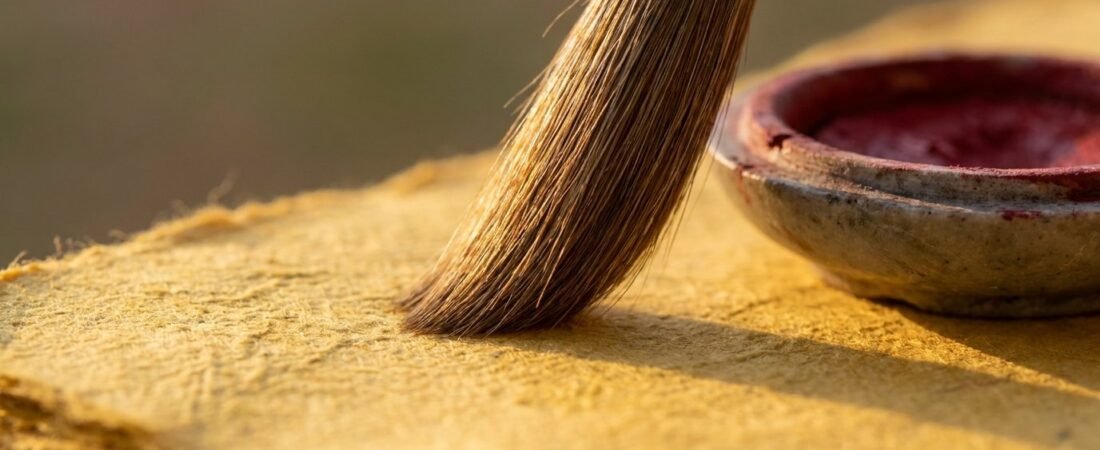
The brush (毛笔, mao bi) is the classical Chinese writing tool, and the conventions of fulu writing grew up around it. A brush responds to pressure and speed: a thicker press makes a bolder stroke, a lifted wrist a finer tail. Those variations are not decoration. In traditional calligraphy, the shape and rhythm of a stroke carry meaning, and a fulu uses the same language.
A stamp or a laser print can copy the shape but not the sequence. Because a fulu is understood as performed in order — often with specific breath and intention at each step — the act of writing is inseparable from the object. A copy has the outline without the event.
The paper: ritual yellow
Fulu are generally written on a specific paper, commonly a yellow sheet (黄纸, huang zhi, “yellow paper”). The colour, like the cinnabar, is traditional and chosen for its associations rather than its chemistry. The paper is usually thin and matt, which matters for handling: it takes a brush stroke cleanly but creases easily, which is why the care advice around folding and storage is stricter than for an ordinary card.
Once written, the piece is folded or mounted with attention to the margins, away from the seal and the head of the design, so the ink does not crack.
How long a fulu keeps
Stored dry and untouched, a cinnabar talisman can stay readable for years; the pigment is chosen partly because it holds where ordinary ink fades. That said, paper ages. Keep a fulu away from damp, direct sun, and heat, and check it now and then for staining or fading. When it finally shows its age, the tradition’s answer is to retire it respectfully rather than to throw it in the bin.
The sequence of writing a fulu
Exact forms differ between lineages, but the broad order is consistent enough to describe.
- Preparation. The surface is cleaned, the tools laid out, and the writer settles their attention.
- Invocation. Many traditions open with a spoken or silent invocation before ink touches paper.
- The head. The writer begins with the opening strokes that mark the top of the design.
- The body. The main sequence of strokes follows, in a set order.
- The seal. A closing mark, often in cinnabar, completes the form.
- Consecration. After writing, the piece is consecrated — kai guang (开光, “opening the light”) — before it is used or shipped.
The order is the literacy of the craft. Someone who has not been trained can imitate the shape; they cannot reproduce the sequence as the tradition intends it.
What “hand-made” does and does not buy you
Be skeptical of anyone selling craft as a guarantee. A hand-drawn fulu is not stronger medicine, and it will not override ordinary reality. What it genuinely offers is:
- A specific, individual object rather than a mass reproduction.
- The marks of a human hand — variation, pressure, small imperfection.
- A piece made inside a transmitted practice, with a written ritual record of its consecration.
What it does not offer is a promise. Treat “hand-made” as a statement about how the object came to be, not about what it will do to your life.
How to tell a hand-drawn fulu from a print
If the materials matter to you, a close look will usually tell:
- Variation between pieces. Hand-written fulu differ slightly in stroke weight. Prints are identical.
- Ink quality. Cinnabar has a faint granular depth; printing ink lies flat and even.
- Stroke ends. A brush leaves tapered, pressed ends. A printer’s edge is uniform.
- The paper. Ritual yellow paper is usually matt and thin; prints often sit on bright, coated stock.
None of this is a trick for spotting fakes — it is simply what the materials look like when a person wrote them.
The limit of the craft
The materials carry meaning because the tradition assigns it. Cinnabar is not magic, the brush is not a wand, and the paper is paper. What the craft does is make the act of intention deliberate: a person prepared, focused, and wrote in order, and another person consecrated the result.
That is the whole claim. A fulu is a beautifully made ritual object with a lineage behind it. It is not, and never was, a machine for forcing outcomes.
The medium matters because it makes the act deliberate — a hand, an order, and a moment of attention.
External references
- Internet Archive — public scans of Taoist texts, including the Daozang tradition.
- Stanford Encyclopedia of Philosophy — Daoism — scholarly background on Taoist text and material culture.
Shop hand-written talismans
At Daofuxuan every talisman is written by hand in cinnabar on ritual yellow paper and consecrated before shipping, with a written ritual record. Orders are taken by WhatsApp appointment — around twelve a day — so each piece gets proper time. Browse the shop or send us a message, and we will help you choose between a personal protection talisman and a protection ritual package.