Editorial note — This is a practical guide to carrying a hand-drawn Taoist talisman (符箓, fulu) from the Maoshan (茅山) tradition we follow: where to wear it, how to store it, and how to look after the paper. These are care and etiquette customs, not rules with promised effects. We make no claim that wearing one changes your outcomes.
First, decide how you will carry it
A folded paper script is delicate, and the way you carry it determines whether it lasts months or years. There are three common forms, and all are traditional.
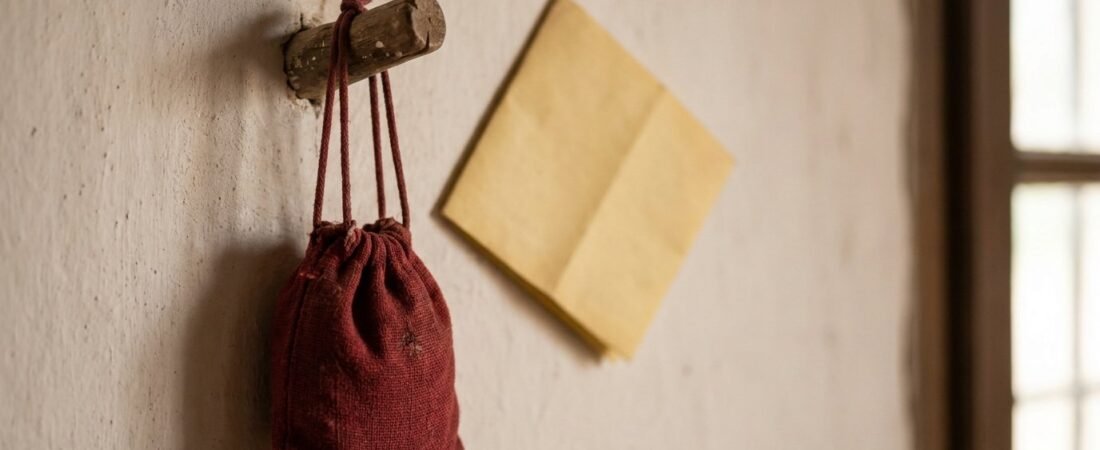
- A cloth pouch — the most common and the most protective. A small fabric sleeve holds the folded script flat and keeps the cinnabar from rubbing off against keys and coins.
- A wallet or card slot — convenient and discreet. Keep it in a dedicated slot, not loose where it will crease and grind.
- Against the body, in a pouch — a small pouch worn under clothing, over the heart or at the waist, is the classic personal-protection placement.
Whatever you choose, the guiding rule is the same: keep the paper flat, dry, and unmangled. Treat it as a document you care about, not a trinket at the bottom of a bag.
Where to place it on the body
Folk custom gives a few preferred placements, none of which is a requirement.
Upper body
A personal script is often kept near the chest or over the heart, whether in a shirt pocket or a pouch worn under clothes. This is the most common placement for a personal-protection talisman.
Waist or pocket
A folded script carried in a trouser or jacket pocket is entirely normal, provided it has a sleeve or a flat inner pocket so it does not crush.
Away from the bathroom
The one placement custom is fairly firm about: not in the bathroom, and not on the floor. Those are treated as the least respectful spots for a written script.
The first time you wear it
Treat the first wearing as a small moment rather than a routine one.
- Wash and dry your hands.
- If you like, read the written ritual record that came with it — a sentence or two about what was made and why.
- State your intention quietly. Name what you want to hold steady, in your own words. This is the point of the object; the wording is not a spell, it is you being honest with yourself.
- Place it where you have decided to keep it, and leave it there.
That is enough. There is no script you must recite and no posture you must hold.
A small warning about the first week: it is normal to feel self-conscious, and it is normal to forget the talisman entirely for a day or two. Neither means you have done it wrong. The object only asks to be treated as something you care about. If you check for it each morning the way you check for your keys, that habit is the whole practice.
Day-to-day care
Once it is on your person, the maintenance is ordinary.
- Keep it dry. Cinnabar (朱砂, zhu sha) and water do not mix, and paper does not survive a wash cycle.
- Remove it for bathing, swimming, and heavy exercise. Practical reasons first — sweat and water will ruin the paper — and customary respect second.
- Set it somewhere clean when you take it off. A nightstand, a shelf, or an inside pocket. Not the bathroom counter or the floor.
- Some people remove it during intimacy. This is a folk custom, not a rule with consequences, and it varies by household. Others simply move it to a nightstand. Either is fine.
Cleaning and refreshing
You cannot wash a paper talisman, and you do not need to. What you can do is keep its surroundings clean.
- Wipe the pouch or the wallet slot with a dry cloth now and then.
- If the script sits on a shelf, dust the shelf, not the paper.
- If the ink begins to flake or the paper tears badly through use, that is normal wear over time. Retire the piece respectfully rather than trying to repair the script itself.
For retirement, follow our guide on respectfully retiring aging paper fulu, and for the wider set of care customs, see talisman care and taboos.
Storage when you are not wearing it
Many people carry a script every day; many others wear it only in particular seasons or situations. If yours spends time stored, a few habits keep it in good condition.
- Flat and dry — a shallow box, a drawer, or a dedicated pouch. Not folded tightly in a stack of papers.
- Away from damp and heat — not next to a radiator, not in a bathroom cabinet, not in a car glovebox through summer.
- Consistent spot — returning it to the same clean place settles it into a small ritual of its own.
- Boxed and private — if you share a flat or prefer not to display the practice, a lidded box is completely acceptable.
If it is dropped, soaked, or lost
These accidents worry people, so here is the plain answer. Dropping a talisman is not an omen. Soaking it is not a sign. Losing it is not a punishment. If it is damaged, the reasonable response is to retire it and, if you still want a script, order a replacement. If you lose one while travelling, you have not offended anyone and nothing follows from it — the practice does not work by threat.
Choosing a script to wear, and what it can and cannot do
What you carry should match what you want it to represent. A Personal Protection Talisman and a Peace and Safety Talisman are both common everyday carries — the first for guarding and steadiness, the second for calm. A Health Talisman is often carried by people recovering or managing a condition, as a companion to proper care rather than a substitute for it. The full range is on our shop page.
Kept honest: a worn talisman is a reminder. It keeps your intention, your promise to yourself, and a bit of ritual in your day. It does not protect you from harm, bring luck, or influence events, and nothing about how you wear it — which pocket, which side, which cord — changes that. The care customs exist so the object stays meaningful and lasts, not because a wrong fold causes a bad outcome.
Each talisman we make is hand-drawn in cinnabar on ritual yellow paper, following the transmitted brush method, and consecrated before it ships, with a written ritual record included.
External references
- Encyclopaedia Britannica — Taoism — background on Taoist ritual and the place of talismans.
- Stanford Encyclopedia of Philosophy — Daoism — a scholarly starting point on Daoist practice.
- Daoist Studies — academic resources on the Daoist tradition.
Shop hand-written talismans
Browse the full collection of hand-drawn cinnabar talismans, made in the Maoshan tradition and consecrated before shipping. We draw each piece individually rather than printing in batches: a single talisman is $329 USD, ritual packages run from $249 to $399, and we accept at most twelve orders a day. Unsure which script to carry day to day? Book a WhatsApp appointment rather than ordering instantly, and we will help you decide and answer any questions about daily wear.