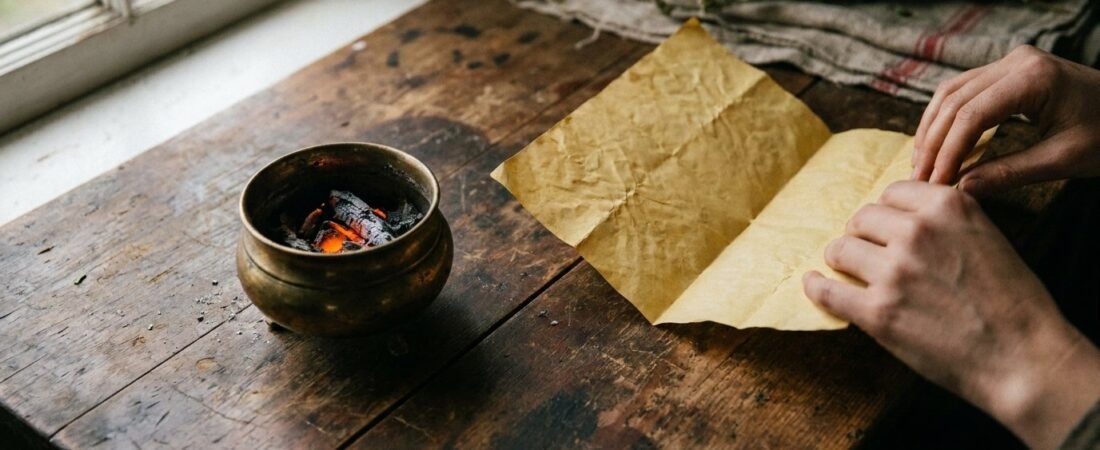
Editorial note · 编辑说明 — A talisman can stay with you for years. This guide covers how the Chinese folk tradition retires a paper talisman (fulu, 符箓) whose time has passed, and the practical, respectful ways to let it go. Everything here reflects how we handle this at Daofuxuan and what the wider tradition records. We do not claim that any step will change events in your life — retiring a talisman is an act of care, not a guarantee.
Why paper talismans age at all
A fulu (符箓, a written Taoist talisman) is drawn in cinnabar (zhusha, 朱砂, a red mineral pigment) on ritual yellow paper. That means it is a physical object, and physical objects age. Paper yellows and grows brittle, creases deepen, cinnabar flakes at the folds, and damp air does its slow work. Any talisman you carry in a wallet or keep folded in a drawer is changing from the day you receive it.
In folk Taoism the paper is understood as a carrier rather than the whole of the practice. The intention, the lineage of the brushstroke, and the ritual of consecration (kai guang, 开光, the moment a talisman is formally empowered) are what the tradition treats as meaningful. The sheet itself is a vessel, and vessels are meant to wear out. Knowing this in advance removes the anxiety many Western seekers feel when they notice their talisman starting to look tired.
What “retiring” a talisman means
To retire a talisman is to end its active role with thanks and dispose of the paper in a way that does not treat it like ordinary trash. In Chinese folk practice this is closer to how you would handle a worn flag or a family photograph than how you would handle a receipt. The object carried meaning, so it leaves with a small measure of respect.
There is no single mandated method. Different households and different regional traditions do it differently, and no text we rely on demands one exact procedure. What the tradition does agree on is tone: quiet, deliberate, and grateful. Retiring is a small ritual in itself, and you can perform it alone, at home, without any specialist present.
Signs a fulu may be ready to retire
People ask us how to know when the time has come. In practice, most keepers notice at least one of these:
- The paper has torn, or a fold has worn through into a hole.
- Cinnabar has rubbed off until the design is largely gone.
- The talisman was soaked, or took on mildew or a musty smell.
- It accompanied a specific chapter — an exam, a move, a hard year — that has clearly closed.
- The keeper simply feels the chapter is finished, even if the paper looks fine.
None of these is a rule from a scripture. They are the ordinary ways a keeper reads a physical object, and any one of them is a reasonable prompt to act.
The respectful sequence, step by step
If you decide to retire a talisman, this sequence keeps the act deliberate. Adapt it; it is a frame, not a law.
- Choose a quiet moment when you will not be rushed.
- Hold the talisman for a few breaths and recall what period of your life it accompanied.
- Thank it — out loud or silently — for being a reminder of your intention.
- Decide on a disposal method you can follow through on (see below).
- Carry out the method without mixing the paper into household waste you would otherwise treat carelessly.
- Wash your hands, and let the matter be closed.
Notice that the emphasis is on your attention, not on an elaborate performance. A three-minute pause done honestly is worth more than a long ceremony done distractedly.
Three customary disposal methods
Burning
Burning is probably the most common method, because fire is traditionally treated as a purifying transition. Use a small heatproof dish outdoors or in a well-ventilated place, never a random stove. Let the paper burn fully, watch it rather than leaving it, and dispose of the cool ash respectfully — some people scatter it in a garden or under a tree, others place it in clean soil. Skip this if open burning is unsafe or restricted where you live.
Burying
Burying returns the paper to the earth and is a quiet option for those who cannot burn. Dig a small hole somewhere you can regard as clean — a garden bed, a planter, the base of a plant — place the talisman in, and cover it. Avoid burying it in a spot you associate with refuse.
Returning to a temple or keeper
If you have access to a temple or a practice community, some people hand the aging talisman over to be dealt with collectively. If you ordered from us, you are welcome to message the Daofuxuan WhatsApp line and ask how to handle a specific piece. We are happy to advise, though we cannot receive and store paper for everyone indefinitely.
What not to do
A few habits undermine the respect the whole practice is trying to keep, and they are worth naming plainly:
- Do not throw a talisman loose into a general rubbish bin without any pause.
- Do not cut, shred, or deface it with anger or contempt.
- Do not leave it lying somewhere it will be stepped on, sat on, or crushed.
- Do not keep a torn, waterlogged, or mildewed talisman in a wallet just to avoid the decision.
None of these will bring harm, but they sit awkwardly next to the intention that led you to keep the talisman in the first place. Treat the disposal as the last respectful act, and you have kept the thread intact.
The paper ends; the intention you set does not. Retire the carrier with thanks and keep the resolve it stood for.
Storing the talismans you keep
Most people are not retiring all their talismans — just the one that has aged. For the rest, a little care extends their life and their meaning. Keep them flat rather than folded if you can, away from direct sun and from humid rooms like a bathroom. A cloth pouch, a small box, or the original protective sleeve is enough. If you carry a talisman like a personal protection talisman or a peace and safety talisman daily, expect it to age faster than one kept at home, and check it once or twice a year.
Handling matters too. Clean, dry hands, a calm moment, and a consistent place to keep the piece all reinforce that this is not clutter. You can read more about everyday handling in our guide to talisman taboos and care.
Replacing versus simply letting go
Some keepers retire one talisman because a new chapter has begun and they want a fresh object for it. Others retire a talisman and go without for a while, which is equally valid. There is no expectation that a retiring talisman must be replaced, and no penalty for waiting. If you do decide to request something new, choose it for the chapter you are actually in, not because the old one “failed.” A talisman was never a machine that ran down; it was a companion to a period of your life, and that period ending is not a malfunction.
External references
- Stanford Encyclopedia of Philosophy — Daoism — scholarly overview of Taoist thought and practice.
- Encyclopaedia Britannica — Taoism — concise background on Taoist ritual and folk religion.
- Internet Archive — home to public scans of Daoist canon material, including the collected scriptures of the Taoist canon.
Shop hand-written talismans
Daofuxuan draws every talisman by hand in cinnabar on ritual yellow paper, following the Maoshan (茅山) brush tradition and the principles recorded in the Wufuxu (五符序), the earliest surviving Taoist scripture devoted to talismans. Orders are handled by WhatsApp appointment rather than instant checkout, because each piece is drawn and consecrated individually. If you are ready for a new chapter, browse the collection at the shop or message us on WhatsApp to talk through your request.