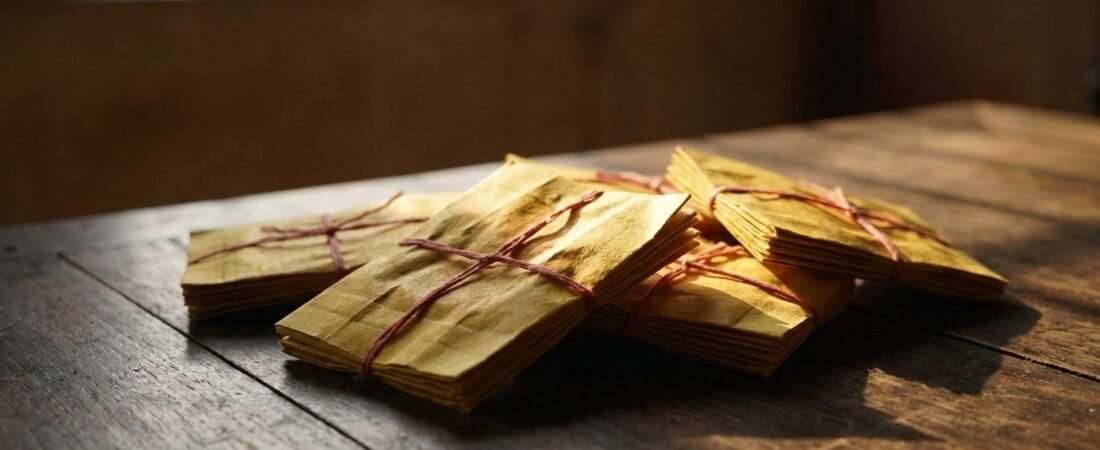
Editorial note · 编辑说明 — This guide explains what a Taoist talisman (fulu) is, where the practice comes from, and what it does not claim to do. Daofuxuan makes and sells hand-written talismans, so we have an interest in the subject; we have kept every factual claim to what the tradition itself records. A talisman here is a ritual object and a written expression of intention, never a guarantee of any outcome.
What the word fulu actually means
English flattens the Chinese term fulu (符箓) into the single word “talisman,” and the flattening loses the point. A fu (符) is a written sign that works like a contract or a summons: it records a request and formally directs it toward a particular power. A lu (箓) is closer to a register or a list — a document that names and authorizes. Read together, fulu means writing that carries authority rather than a charm you rub for luck.
That difference matters if you grew up with European folklore. A Western charm is often passive; it sits in a pocket and does its quiet work. A fulu is active and administrative, closer to a sealed letter than to a lucky coin. The writing itself is part of the ritual, not decoration added afterward, and the person who writes it is doing something specific at the moment the brush touches the paper.
Where the practice comes from
Talisman writing is older than any single text, but the tradition we work within is specific. Daofuxuan follows the Maoshan (茅山) tradition and the scripture known as the Wufuxu (五符序), short for the Taishang Dongxuan Lingbao Wufu Xu, “The Five Talismans of the Numinous Treasure.”
That scripture is the earliest surviving Taoist text devoted specifically to talismans. It was gathered into the Zhengtong Daozang (正统道藏), the 1445 imperial collection of Taoist writings. Being the earliest surviving text on the subject does not make it magical or hidden; it makes it a document you can actually look up, which is the kind of claim we prefer to make.
Naming the source has a practical use. A great deal of what circulates online about talismans comes from no source at all — a symbol lifted from a film, a blessing invented for a product page. Knowing that a design descends from a named scripture and a named regional tradition lets you ask sharper questions of anyone selling you one.
What is drawn on a talisman
A fu is not a single picture. It is a small composition, and its parts usually do different jobs:
- The invocation or heading — a line that states what is being requested and of whom.
- The central figure — a stylized character, a set of linked strokes, or a diagram that carries the main meaning of the talisman.
- Seals and marks — small signs that authorize the document, the way a signature authenticates a letter.
- The closing stroke or point — the final mark that completes the writing.
To an untrained eye the whole thing can look like one dense squiggle. It is more useful to think of it as handwriting with a grammar: strokes that begin, connect, and end in specific ways. Learning to read every symbol takes years, which is why we tell Western buyers not to try. You are not expected to parse it. You are expected to keep it as it is.
Why cinnabar on yellow paper
Two materials appear again and again in the tradition. The first is cinnabar, or zhu sha (朱砂), a red mineral pigment long associated with vitality and with writing that is meant to last. The second is huang zhi (黄纸), the yellow ritual paper used for fu.
Yellow carries the association of the center and of earth in Chinese cosmology; red carries the association of life and yang (阳). Neither choice is decorative. A fu is written with a specific ink on a specific ground because the materials are treated as part of the request, not as packaging around it. This is also why we do not print talismans in black toner on white stock and call them the same thing.
Brush versus pen
The stroke order, speed, and pressure of a brush differ from those of a pen or a printer. Hand-writing a fu means the shape can respond to the moment of writing — the hand slows, fills, and finishes on the page. That is a real difference in how the object is made, and it is the subject of a separate article in this series.
Consecration, or kai guang
A written fu is not treated as finished the moment the ink dries. It is consecrated, a step called kai guang (开光), which literally suggests “opening the light.” In practice it is a short ritual that formally activates the talisman and dedicates it to its stated purpose. The written form and the consecration belong together; one without the other is incomplete in the tradition’s own terms.
We cannot show you a video of this step, and we say so plainly: we do not produce filmed proof of consecration. What we provide instead is a written ritual record — a short document noting what was done, for whom, and when. It is a paper trail, not a performance, and it is the document you can actually keep.
What a talisman is not
This is the section we would rather write than skip. A fulu is not a medical treatment, a financial strategy, or a way to control another person. If you are ill, the first step is a doctor; a talisman does not replace medical care and we will not imply that it does. If you want a relationship, a love-harmony fu is never used to bind or manipulate someone — in our framing it speaks to your own state and to harmony between people, not to another person’s will.
We also do not promise wealth, health, or love as results. The honest description is simpler: a talisman is a ritual expression of intention, made carefully and kept with respect. What you do with that intention afterward is still yours to do.
How people outside China use fulu
Most of our customers are in the United States, Europe, and Australia. They tend to fall into a few patterns. Some want a physical focus for a goal they are already working toward. Some are drawn to the symbolic and material life of the object. Some are reassembling a practice their family lost. None of these require you to believe anything in particular, and none of them require you to read Chinese.
If you are new, the sensible order is: understand what the object is, decide what intention you are actually naming, and only then choose a form. Buying first and figuring out the meaning later tends to leave people with a talisman they do not understand and therefore cannot keep well. The rest of this series walks through those steps in order.
External references
- Stanford Encyclopedia of Philosophy — Daoism — a careful academic overview of Taoist thought and its texts.
- Encyclopaedia Britannica — Taoism — background on Taoism as a religion and on its ritual life.
- Daoist Studies — an academic portal for research on Taoist practice and scripture.
- Internet Archive — public scans that include editions of the Taoist canon.
Shop hand-written talismans
Every talisman at Daofuxuan is drawn by hand in cinnabar on yellow ritual paper, following the Maoshan tradition, and comes with a written ritual record. Single talismans are $329, and ritual packages begin at $249. Because each one is written individually, we take orders through WhatsApp rather than instant checkout, and we accept up to 12 orders a day. Browse the collection at the shop, or begin with a personal protection talisman or a peace and safety talisman if you are not sure where to start.