Editorial note — This article is a reader’s guide to the visual parts of a fulu (符箓, a written talisman): its head, body, foot, cloud script, and seal. We explain what the elements signal within the tradition. We do not claim the symbols have measurable powers, and there is no single key that “decodes” every talisman.
Why a fulu cannot be read like a sentence
The first thing Western readers try to do with a talisman is read it. That instinct runs into a wall almost immediately, and the wall is real: a fulu is not written in ordinary Chinese, and it does not spell out a message the way a sign or a letter does.
A fulu is closer to a diagram than a paragraph. It combines recognizable characters, invented composite glyphs, symbolic shapes, and stamped seals into a single composition whose meaning is ritual rather than linguistic. Think of it the way you think of a coat of arms: you can name every element, but the point is not to read it aloud.
This is why traditions have always transmitted fulu through a teacher rather than a dictionary. At Daofuxuan we work from the Maoshan method and from the Wufuxu (《太上洞玄靈寶五符序》, the earliest surviving Taoist scripture devoted to talismans), and even there the glyphs are learned by copying, not by looking them up.
The three-part anatomy: head, body, foot
Many fulu share a loose structure that practitioners describe in three parts, borrowing the language of the body.
- The head (符頭, fu tou) — the top of the sheet, where the talisman states its authority. This is often a three-stroke mark recalling the Three Pure Ones, or the phrase chi ling (敕令, the imperial command) that licenses the power being invoked.
- The body (符腹, fu fu) — the dense middle section, where the petition or intention is carried. This is where the heavily stylized characters usually sit, often stacked vertically in a compressed script.
- The foot (符腳, fu jiao) — the base of the talisman, frequently a star pattern or a character such as gang (罡) evoking the Big Dipper, which many lineages treat as a foundation of power.
Once you know to look for these three zones, a fulu stops looking like a random scribble and starts looking like a built object with a top, a middle, and a base.
Cloud script: the “seal script of the sky”
Some of the most beautiful fulu glyphs belong to yunzhuan (雲篆, “cloud seal script”), sometimes called celestial or cloud script. The name comes from the way the strokes curl and coil like cloud forms or smoke.
Cloud script is not a font. It is a family of stylized characters used mainly in religious writing, where ordinary readability is deliberately sacrificed for symbolic density. A single coiled figure may be a compressed version of a longer phrase, a deity’s name, or a graphic invocation. Its beauty is part of its function: the script is meant to look otherworldly because it stands for something that belongs to the sacred rather than the everyday.
A reader can think of cloud script the way a musician thinks of a notation that no longer matches modern staff paper: it is readable to the trained, meaningful to anyone who recognizes what it is, and not designed for the casual glance. Recognizing the register, even without reading it, is a genuine form of understanding.
The command line: 敕令 and stacked characters
If you look at many talismans you will keep meeting one phrase: chi ling (敕令). It reads as an imperial or authoritative command — the talisman “orders” rather than “asks,” a rhetorical move borrowed from the language of state decrees.
Below or around the command you will often find characters pushed together into a single block. These are he ti zi (合體字, “combined-body characters”), where two or three ordinary characters share one square of space. The result reads as a compressed word, and its density is part of the point: the more is packed in, the more the talisman is meant to carry.
Recognizing chi ling is the single most useful skill a beginner can develop. It shows up again and again and marks, in a way, where the talisman’s voice begins.
Seals: the red stamp that authenticates
Nearly every finished talisman carries one or more seal impressions, made with cinnabar (朱砂) and a carved seal (印). These are the fa yin (法印, “dharma seals”) of a lineage, not decoration.
A seal does two jobs. First, it authenticates: the specific stamp ties the talisman to the tradition and workshop that produced it. Second, it completes: in many lineages the talisman is not considered finished until the seal is applied, a step we describe in our piece on how a wealth fulu is written. When you see a red stamp crowding the paper, you are looking at the talisman’s signature and its closing act.
Color and material as symbols
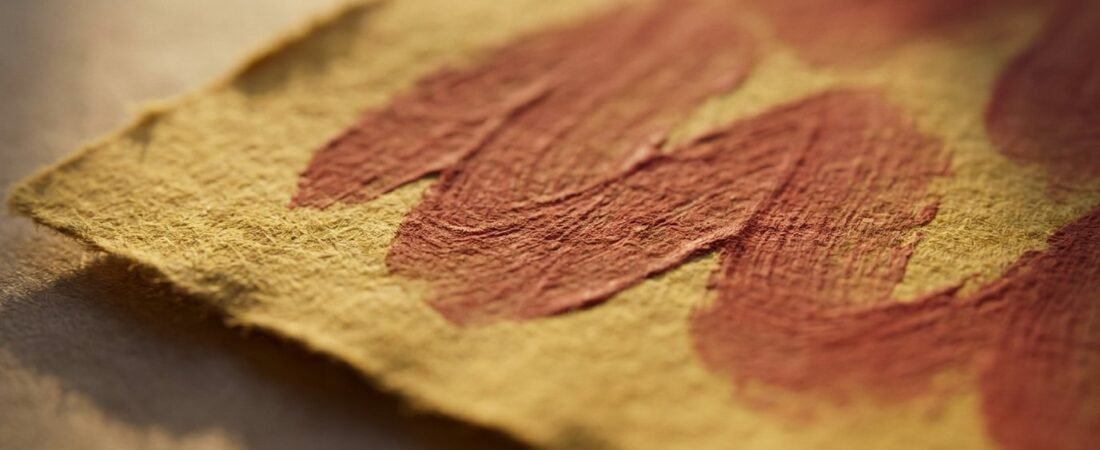
Two material choices carry meaning that a reader can see instantly. Yellow paper (黄纸) and cinnabar ink are not random: the yellow ground and the red strokes are the traditional pairing for fulu across the Chinese world.
Cinnabar is a mineral pigment with a long association with ritual and protection, and its brightness against yellow is the visual signature of a hand-drawn talisman. This is one reason we draw everything by hand rather than printing: a print can reproduce the shapes but not the fact that each stroke was laid down in cinnabar by a brush.
That pairing is why a printed talisman can look superficially similar and still feel different in the hand. Print lays uniform ink on uniform stock; a brush varies pressure, thickness, and the small irregularities of a human hand. Those variations are not defects. They are the visible trace of the method.
How to approach a fulu as a viewer
Start at the top and work down, the way the writing was laid out. Find the head and look for the command; move into the body and notice where the dense glyphs cluster; arrive at the foot and look for a star or base mark; then find the seal.
Ask what the talisman is for, not what it “says.” A warding talisman and a Five Thunder talisman draw on different visual vocabularies because they belong to different intentions. Reading the purpose first, and the symbols second, keeps you from expecting a translated sentence that was never there.
Honest limits
No article, including this one, gives you a universal key to fulu. Different lineages use different house glyphs, and a character that means one thing in one tradition can be reshaped in another. If a source promises you a single chart that “translates” every talisman, that promise is worth doubting.
What you can learn reliably is structure, register, and the few recurring markers — head, command, body, foot, seal. That is enough to look at a fulu with understanding instead of confusion.
External references
- Daoist Studies — scholarly portal for Daoist textual and ritual study.
- Encyclopaedia Britannica — Taoism — overview of Taoist symbols and practice.
- Internet Archive — public scans of Daoist texts where talisman forms appear.
Shop hand-written talismans
Our shop offers hand-brushed fulu in which every head, body, foot, and seal is drawn the traditional way, in cinnabar on yellow paper, then consecrated with kai guang. Each is made to order — up to twelve a day — so orders are arranged by appointment on WhatsApp rather than an instant cart. If you would like to see how the parts come together, a home protection talisman is a good place to start.