Editorial note — This article explains kai guang (开光, consecration) and the written ritual record we prepare after every rite at Daofuxuan. We describe the process as our Maoshan line hands it down, and we show you what the document actually contains. We do not film consecrations, and nothing here promises an outcome in your life.
What “kai guang” actually refers to
Kai guang (开光) translates roughly as “opening the light.” In Chinese religious practice the phrase names the rite that formally activates a sacred object — a statue, a plaque, an altar image, or a written talisman. The image behind the term is simple: a figure that has been carved or painted is, in a sense, still looking inward; the rite “opens” its eyes so that it can face the world and serve its purpose.
For a fulu (符箓, a written talisman), kai guang is the step that moves a sheet of inscribed paper from “something written in the traditional manner” to “a consecrated object within the lineage.” The writing and the consecration are two distinct acts, done at different moments, sometimes on different days.
That distinction matters when you ask what you are actually buying. A hand-written talisman is a physical object — a slip of yellow paper brushed with cinnabar ink. Kai guang is a ritual act performed over it. We can describe both honestly. We cannot photograph the second in a way that would carry the meaning a practitioner cares about.
Why people look for “proof” of a consecration
Buying a religious object across borders raises a fair question: how do I know the rite you describe was really done? The instinct is to want evidence — a recording, a photo, a timestamped clip.
The instinct is understandable. It is also worth being honest about its limits. A spiritual act is not the kind of event a camera settles. Footage of someone moving their hands over paper proves that hands moved over paper. It does not establish the thing that matters inside the tradition, which is an intention and a transmission that practitioners treat as interior. Two workshops can post near-identical clips and mean entirely different things by them.
There is a second problem with treating footage as proof: it scales. Anyone can produce a recording quickly and cheaply, which means the presence of a clip tells you almost nothing about the care behind an object. A workshop that films every order can generate the same volume of material whether the work is careful or careless. Documentation that names a date, a source line, and a seal is comparatively hard to manufacture convincingly in bulk.
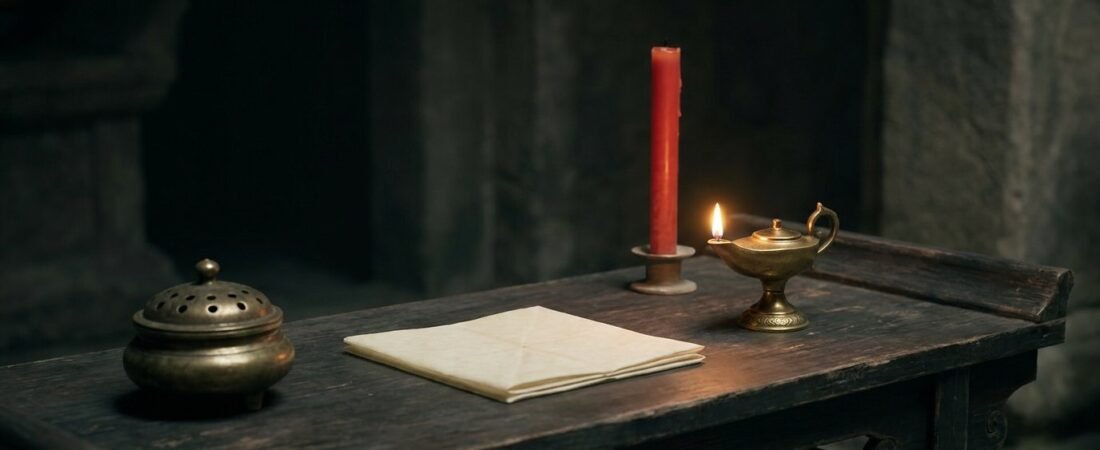
So at Daofuxuan we do something simpler and, we think, more useful: we keep a written ritual record (书面科仪记录) for every order, and it travels with your talisman.
What our written ritual record contains
The record is a short document, not a decorative certificate. It lists the facts of the rite so that you can read, months later, exactly what was done and when.
- The date the talisman was written and the date it was consecrated.
- The name you supplied, or a short code if you asked to stay anonymous.
- The type of fulu requested, and the focus you described in your WhatsApp conversation.
- The day and hour selected for the rite, taken from the traditional calendar rather than picked at random.
- The line of source text invoked, drawn from the Wufuxu (《太上洞玄靈寶五符序》, the earliest surviving Taoist scripture devoted to talismans).
- The seal (印, the red stamp) applied to the sheet, and the workshop’s own mark, so the document can be matched to the exact object you hold.
A record, not a certificate
We deliberately keep the document unadorned. There is no gold border, no invented seal of authority beyond the workshop’s own mark, and no language that overstates what happened. An ornate certificate is easy to fake and easy to read as a claim we cannot support. A plain list of dates, names, and source lines is harder to misunderstand — and if you ever compare two of our records side by side, you will see that they differ, because the rites did.
None of this proves a supernatural event, and we do not present it as though it does. What it does is make the process accountable: a specific rite, on a specific day, recorded in a specific document, tied to the object in your hands.
Why we chose paper over a recording
There are three reasons, and the first is plain honesty. Telling you a clip “proves” a consecration would be a larger claim than we can stand behind. We would rather show you a document that says less and means exactly what it says than a film that implies more than anyone can deliver.
The second is respect for the practice. What happens during kai guang is not a performance for an audience. Turning an interior act into shareable content changes what it is, and tradition-minded practitioners have always been cautious about that.
The third is that a document is genuinely more useful to you. A recording is watched once and forgotten. A written record can be kept with the talisman, reread when you wonder when it was made, and used to distinguish a documented object from an anonymous one.
How to read your record when it arrives
Start with the two dates. The gap between writing and consecration tells you the object was not rushed off a shelf; it was drawn on one day and ritually completed on another.
Then read the focus you set. If you asked for steadiness during a move and the record describes a peace talisman, the match confirms your request was carried into the work. If something looks off, that is exactly the moment to message us on WhatsApp and ask — the record exists to make that conversation possible.
Finally, check the seal and the workshop mark against the paper itself. A record that matches the object is a small thing, but it is the only kind of evidence this transaction can honestly offer.
What the record cannot tell you
It cannot tell you that your fortunes will change, that money will arrive, or that harm will avoid you. We do not make those claims about any fulu, and a document would not make them true.
A fair question here is what happens if something is wrong with the record. The answer is simple: tell us, and we will correct it or explain it. The document exists so that a real person on our side can be held to a real description of the work, and that only functions if you feel free to ask questions about it.
What a consecrated object offers, as we understand it, is a ritual expression of intention — a physical anchor for a focus you have chosen, made within a living tradition and recorded so you know what you received. The rest is your life, your choices, and the ordinary uncertainty everyone carries.
If that is the kind of object you are looking for, the process below is how to begin.
External references
- Encyclopaedia Britannica — Taoism — background on Taoist ritual and its place in Chinese religion.
- Stanford Encyclopedia of Philosophy — Daoism — scholarly overview of Daoist thought and practice.
- Daoist Studies — an academic portal for Daoism research resources.
Shop hand-written talismans
Every talisman in our shop is brushed by hand in cinnabar on ritual yellow paper and consecrated with kai guang, then sent with a written ritual record. Because each one is made to order and we complete up to twelve a day, we take orders by appointment on WhatsApp rather than through an instant checkout. Message us with the focus you have in mind and we will confirm the timeline. You can also start with a peace and safety talisman or a personal protection talisman if you are new to this.