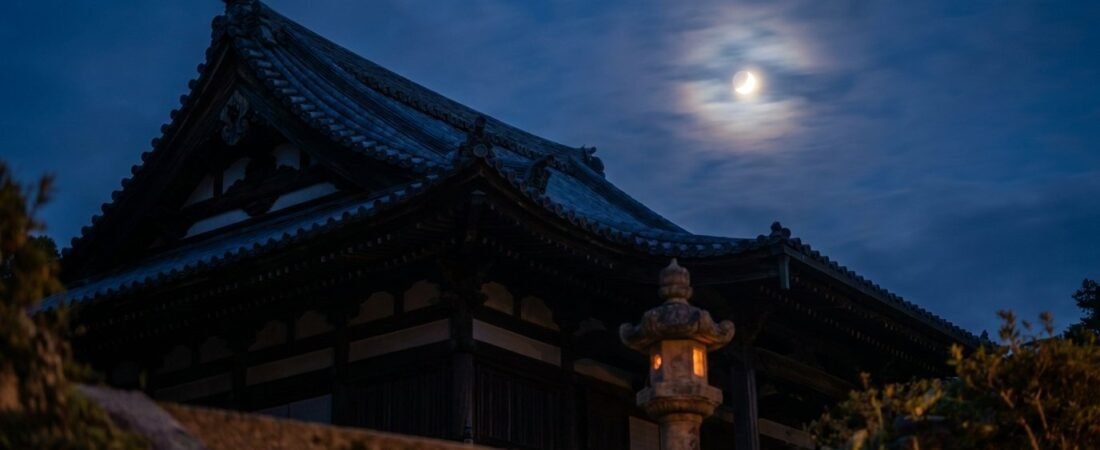
Editorial note · 编辑说明 — This is a beginner’s guide to how the lunar calendar and the moon’s phases shape timing in Chinese folk Taoist ritual. We explain what the tradition observes and why, and how a Western seeker can work with those rhythms without treating them as a control panel for events. We describe practice; we do not promise outcomes.
Why timing matters in ritual
Anyone who grew up around a temple or a family altar in the Chinese-speaking world learns early that when you do something can matter as much as what you do. Offerings, requests, and household observances are often scheduled around the lunar calendar (nongli, 农历, the agricultural lunar calendar still used for festivals). This is not superstition in the dismissive sense — it is a system for placing human activity inside the rhythm of the natural world.
The moon is the most visible clock in that rhythm. It waxes and wanes on a cycle of roughly twenty-nine and a half days, and folk practice has long used its phases as a rough map for when to begin, when to give thanks, and when to rest. For a seeker arriving from outside the tradition, the point is not to memorize a rulebook but to understand the logic, so the timing feels meaningful rather than arbitrary.
The lunar month in plain terms
The Chinese lunar month begins on the day of the new moon and runs to the day before the next one. Because that cycle is not a whole number of days, months run twenty-nine or thirty days, and the calendar is periodically adjusted to stay aligned with the seasons. Festivals you may have heard of — Lunar New Year, the Lantern Festival, the Mid-Autumn Festival — all sit at fixed points in this cycle rather than on fixed solar dates.
Two features of the month draw the most attention in practice. The first day, tied to the new moon, is a natural starting point. The fifteenth day, tied to the full moon, is a natural high point. Folk observance tends to cluster at these two poles, with the rest of the month arranged between them.
The new moon: beginnings
The new moon, when the moon is dark and hidden, is associated with beginnings and quiet intentions. In folk practice it is a common time to make a fresh start: setting a new resolve, opening a period of practice, or asking someone to draw a new talisman for a chapter you are entering. The dark sky is read as a blank page rather than an absence.
If you keep a small altar or table for your practice, a simple new-moon observance might be a glass of water, a stick of incense, and a few minutes of quiet attention to what you hope to begin. The emphasis is on clarity of intention, not on volume or expense.
The full moon: culmination and thanks
The full moon, on or around the fifteenth, is associated with culmination and gratitude. It is a natural moment to mark what has come to fullness, to give thanks for what has gone well, and to offer thanks for a period that is closing. Many regional traditions hold that the fifteenth of the month is especially suitable for gratitude offerings.
Because the full moon is bright and easy to observe, it is often the easier of the two poles for a beginner to track. Mark it on your phone for a few months and you will start to feel the rhythm without consulting a calendar each time.
Waxing and waning: growing and releasing
Between the two poles, the month divides into a growing half (waxing, from new to full) and a receding half (waning, from full to new). Folk practice loosely pairs the waxing half with building — starting, adding, strengthening an intention — and the waning half with releasing, simplifying, and letting go.
This is a soft convention, not a switch. A waxing moon does not make a request “stronger,” and a waning moon does not make one “weaker.” What it offers is a felt sense of direction: are you in a season of gathering or a season of clearing? Aligning your action to that sense makes the action feel coherent, which is its own kind of value.
Auspicious and inauspicious days
Beyond the moon, folk practice also attends to the quality of individual days. You will see the terms ji (吉, auspicious or favourable) and xiong (凶, inauspicious or unfavourable) used in traditional almanacs. Historically these classifications combined lunar data, the solar terms, and the twelve-day cycle of officer days, among other inputs, and were used to choose days for weddings, moves, and openings.
For a modern seeker abroad, the practical version is modest. You do not need to master the almanac to keep a practice. But if you have the chance to schedule something like a home blessing on a day you regard as calm and uncluttered, rather than on a frantic one, that aligns with the spirit of the tradition — even if you never open an almanac at all.
How to work with lunar timing: a simple method
- Note the new moon and the full moon each month; those two anchors carry most of the meaning.
- Use the waxing half for beginnings — new intentions, fresh requests, starting a practice.
- Use the waning half for thanks and release — completing, expressing gratitude, letting go.
- Mark seasonal festivals when they fall, since they sit at fixed points in the cycle.
- Keep it light; a rhythm you can maintain beats a rulebook you abandon after a month.
If you are planning to request a piece such as a luck-turning talisman for a new beginning, or a Tai Sui talisman tied to the year’s cycle, it is entirely reasonable to time the request to the new moon or to a seasonal turning point. That choice is about your own attention and consistency.
Common misconceptions
A few ideas circulate online that the tradition itself does not support. It is worth setting them aside:
- That a particular phase “guarantees” a result — no phase does, because practice is about intention, not control.
- That you must perform a ritual on exactly the right day or it is wasted — folk practice is more forgiving than that.
- That the moon’s phases dictate events in your life — the calendar is a way of structuring attention, not a lever on outcomes.
- That timing matters only for “advanced” practitioners — beginners can observe the two anchors and benefit from the rhythm immediately.
The calendar does not move the world for you. It gives your intention a place to stand, so the same act carries more weight because it was placed with care.
Timing is a support, not the point. If you find yourself anxious about hitting the perfect day, you have drifted from the spirit of the practice, which is calm and unhurried by nature. Use the moon as a gentle guide, miss a month when life is busy, and come back without guilt. The rhythms of the tradition are meant to make practice easier to keep, not to add a chore.
External references
- Encyclopaedia Britannica — Taoism — background on Taoist ritual and popular religion.
- Stanford Encyclopedia of Philosophy — Daoism — scholarly context on Taoist cosmology and practice.
- Daoist Studies — a portal for academic work on the Taoist tradition.
Shop hand-written talismans
At Daofuxuan, every talisman is drawn by hand in cinnabar on ritual yellow paper, following the Maoshan (茅山) brush tradition and the Wufuxu (五符序), the earliest surviving Taoist scripture devoted to talismans. Orders are taken by WhatsApp appointment so each piece can be drawn and consecrated individually. To request a talisman for a beginning you are about to mark, browse the shop or message us on WhatsApp.