Editorial note · 编辑说明 — This article explains the traditional logic behind three things buyers ask about most: when a talisman is written, what it is written on, and how intention enters the process. Daofuxuan makes talismans, so we describe the reasoning we were taught. The symbolism shapes the act of making; it does not guarantee an outcome.
Why the tradition cares about timing
Taoist ritual treats time as having quality, not just duration. Some days are understood as more suitable for beginning a certain kind of work than others, the way a farmer would not plant out of season. When a talisman is written, the day and hour are part of the act, not incidental to it.
This is the logic behind the practice often called ze shi (择时, “choosing the time”). It rests on correspondence: the idea that ritual action works best when it aligns with the pattern of the moment. You do not have to accept that as metaphysics to understand it as a discipline. Setting aside a fitting time forces the writer to slow down and take the act seriously, and that seriousness is a large part of what makes ritual different from manufacture.
How a day is chosen
The traditional method draws on the calendar of heavenly stems and earthly branches, gan zhi (干支), a repeating cycle used to count days, months, and years. Practitioners combine it with the lunar calendar and with rules particular to the kind of business being started. Certain days are favored for beginnings, others for ending or clearing, and some days are avoided for particular purposes.
It is important to be honest about what this is. Choosing a day is a symbolic alignment, not a weather forecast for the future, and no one who respects the tradition will tell you that picking Tuesday instead of Wednesday determines whether your business succeeds. The day shapes the ritual; it does not steer your life. Understood that way, the calendar is a tool for attention rather than a machine for predictions.
Paper: why yellow
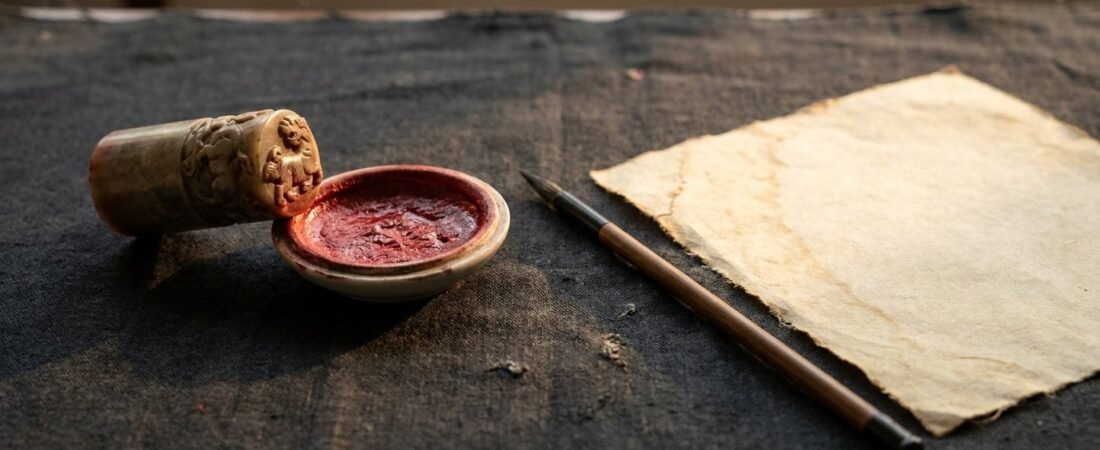
Traditional talismans are written on huang zhi (黄纸), yellow ritual paper. Yellow is associated with the center and with earth in Chinese cosmology, and the center is the position of balance — the point from which the four directions are ordered. A talisman is written on yellow because it is being placed, symbolically, at the center of a matter.
The paper is also chosen to be written on. It has a texture that holds brushstrokes, and it is treated as a ritual material rather than a blank sheet from a stationery cupboard. In our own work we keep to yellow ritual paper, and we say so, because a buyer deserves to know what a talisman is actually made from.
Cinnabar: why red
The ink is traditionally cinnabar, zhu sha (朱砂), a red mineral pigment. Red carries the association of life, vitality, and yang (阳) — the active, bright, rising aspect of things. Writing a fu (符, a written sign) in red is thus a small statement about what the writing is for: not recording a fact, but marking a living intention.
Material matters, too. Cinnabar has weight and a slightly uneven flow that differs from modern ink, and the brush responds to it differently than a pen would. When you hold a hand-written talisman, the red is not uniform, and it is not supposed to be. That irregularity is a record of a hand doing work on a particular day.
Intention: naming what you ask
Before anything is written, the intention has to be named. In practice this is more demanding than it sounds. “Good luck” is not an intention; it is a hope with no shape. “Steadiness while I open a business” is an intention — specific enough to write toward and specific enough to keep.
This is where most of the tradition’s weight actually sits, and it is why we ask questions before we write. A talisman written for a vague wish produces a vague object. A talisman written for a named purpose has something to focus. The intention, not the symbol, is what the buyer brings; the form is what the tradition brings.
A practical test for a named intention is whether you could tell, months later, whether you had moved toward it. “I want to feel steadier while I build this” passes, because you can notice steadiness or its absence. “I want everything to be good” fails, because nothing specific was ever asked for. Vague intentions produce talismans that no one, including the person who receives them, can keep well.
Two people can receive a talisman with the same design and end up with different objects, because the intention written into each one is different. The form is a container; the intention is the contents.
The writing moment
The writing itself is a short, focused act rather than a factory step. The writer sets the materials, settles the mind, and draws the fu without interruption — breath and brush together, stroke following stroke to its completion. The speed and pressure of the brush vary from one piece to the next, which is exactly why a hand-written talisman does not look machine-perfect.
When the writing is finished, the talisman is not yet treated as complete. It is consecrated, a step called kai guang (开光, “opening the light”), which formally activates it and dedicates it to the stated purpose. We keep a written ritual record of this for each order. We do not film it, and we do not claim to.
What the symbolism does and does not do
It may help to separate two questions that marketing tends to fuse. What does the symbolism do within the ritual? And what does the talisman do for your life? The first is the tradition’s own business: the timing, the paper, the ink, and the intention are what make the act of writing a ritual rather than a craft exercise. The second is not something anyone can promise.
A fulu (符箓, a written talisman) is a ritual expression of intention. It is not a guarantee, not a medical treatment, and never a means of binding another person. If you want to mark a beginning, a protection, or a turn, that is what a talisman is for. The symbolism makes the marking real and careful; it does not take the outcome out of your hands.
Read everything above as an explanation of how a talisman is made, not as a claim about what it will do for you once it is in your hands. The making is what we can promise to do carefully; the rest belongs to the life you live with it.
External references
- Daoist Studies — research on Taoist ritual, calendars, and material practice.
- Encyclopaedia Britannica — Taoism — background on Taoist ritual and its symbolic world.
- Internet Archive — public scans including editions of the Taoist canon.
Shop hand-written talismans
Each talisman at Daofuxuan is written by hand in cinnabar on yellow ritual paper, timed and consecrated according to the Maoshan tradition, and covered by a written ritual record. Single talismans are $329; packages begin at $249. We book through WhatsApp and take up to 12 orders a day. See the range at the shop, or look at a five thunder talisman or a Tai Sui talisman as examples of forms tied closely to timing.